Polymarket Taiwan Invasion Markets: How to Read the Odds

Polymarket lists several contracts on whether China will invade Taiwan, each with a different deadline and its own wording. The prices are low, the volume is large, and the numbers move with headlines. To use them as evidence, read each contract's resolution rules first, compare the deadlines side by side, and check the price against sources that do not come from the market itself. That is the workflow Glypse is built around: cross-venue search, cited event briefings and social sentiment data in one workspace.
This guide covers what the contracts say, what the prices and volumes looked like in 2026, how to interpret them, and how to separate real signals from noise.
Key Takeaways
- Polymarket's invasion contracts differ by deadline: end of 2026, June 30, 2027 and December 31, 2027 each trade at a different price, and a separate "military clash" family uses different wording.
- A price is a trader consensus at one moment, expressed as a probability. Polymarket's own page says odds are not a guarantee of what will happen.
- Read the rules before the odds. The end-2026 contract resolves on a military offensive intended to establish control over any part of Taiwan's territory, with specific rules on islands.
- Treat volume, large trades and social chatter as signals to investigate, then check them against official assessments such as the U.S.-China Economic and Security Review Commission's 2026 report.
- Glypse's free research tools let you search related contracts across venues, review price history and track social sentiment in one place.
What the Polymarket Taiwan contracts actually ask
The word "invasion" means different things in different contracts, so the first job is reading the rules text. For the end-of-2026 market, the resolution rules say it resolves Yes if China commences a military offensive intended to establish control over any portion of the Republic of China (Taiwan) by December 31, 2026, 11:59 PM ET. Otherwise it resolves No. Territory administered by the Republic of China, including inhabited islands, qualifies, while uninhabited islands do not.
Three details matter for anyone researching this market:
- Intent and action. The wording asks for the start of a military offensive with a purpose: establishing control. A blockade, a cyberattack or an incident at sea is a different kind of event, and you should check whether a given contract's rules count it.
- "Any portion." A limited operation against an inhabited outlying island would fall within the text, so the contract is not only about a full amphibious landing on the main island.
- A fixed cutoff. The contract is time-boxed to a date and time in Eastern Time. A later event does not count, however closely it follows.
Polymarket also lists a separate family titled "China x Taiwan military clash by...?", with its own rules. A clash market and an invasion market can sit at different prices because they ask different questions. Always open the Rules tab on the specific contract rather than assuming the title tells you everything.
What the prices and volume looked like in 2026
The contracts below are the ones most traders compare. The figures are readings from Polymarket's own pages during 2026. They move continuously, so use them as a snapshot of the shape of the curve and check the live pages for current values.
| Contract | Yes price when read | Total volume when read |
|---|---|---|
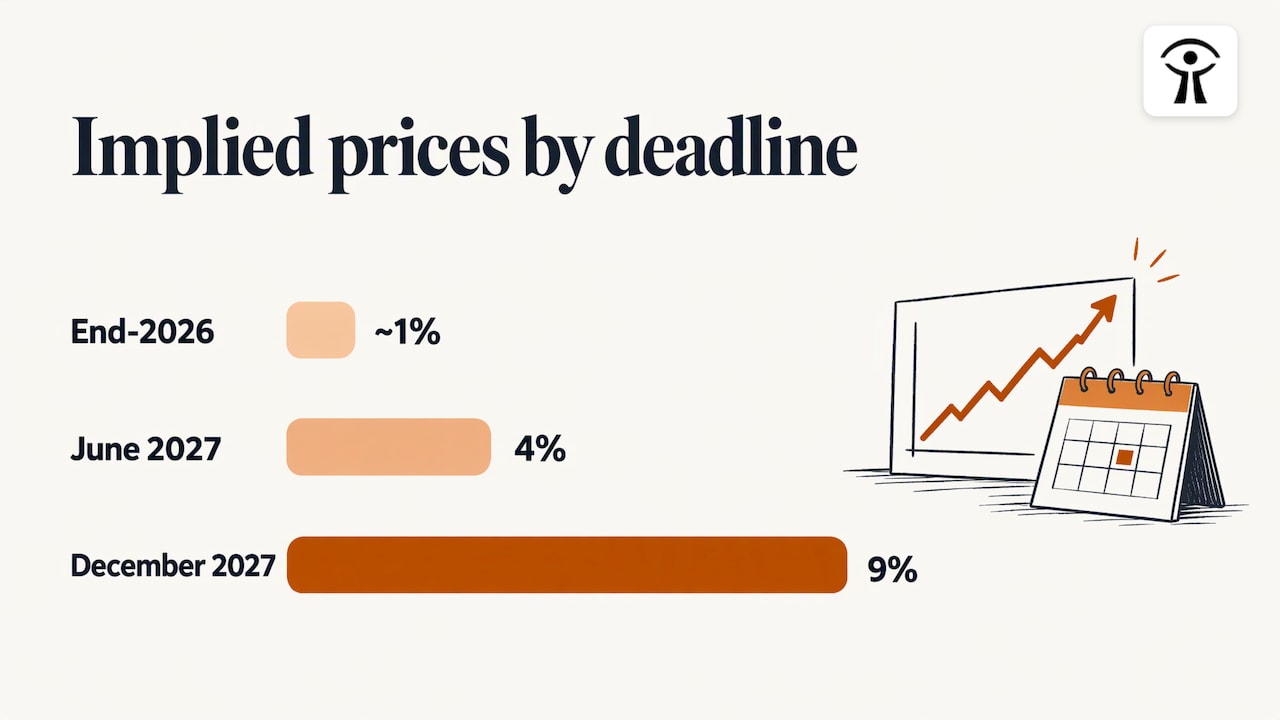
| China invades Taiwan by end of 2026 | about 1% | $47,525,770 |
| China invades Taiwan by June 30, 2027 | 4% | $624,978 |
| China invades Taiwan by December 31, 2027 | 9% | $4,079,812 |
Polymarket's China page showed the December 2027 contract at 9% with about $4M in volume, and described the end-2026 market at about $48M.
Three patterns stand out.
Longer windows carry higher prices. The curve rises from about 1% for end-2026 to 4% for mid-2027 and 9% for the end of 2027. That is what you would expect if traders assign a small probability to each additional period. The step from June to December 2027 adds five points over six months, which is steeper than the step from end-2026 to June 2027.
Volume does not follow the price. The end-2026 contract is the oldest. It opened on July 24, 2025, and has had the longest time to collect trading. The June 2027 contract has far less volume than the December 2027 one. Total volume measures how much has traded over a contract's life, not how much conviction sits behind today's price.
The end-2026 contract is about to expire. It ends on December 31, 2026. Contracts like this one roll forward: when a deadline passes, traders move to the next one. Expect new year-based contracts to appear and the focus to shift to the 2027 windows. Check the Polymarket China page for the current list.
How to interpret implied probability
A winning share on Polymarket pays $1, so a price of 4 cents corresponds to an implied probability of about 4%. Polymarket's China page explains that because traders risk real capital, prices aggregate many participants' information into a single probability. The same page cautions that no market is a guarantee, and that odds represent trader consensus at a point in time rather than a prediction of what will happen.
For your research, that framing supports a few habits.
Convert price into a claim you can test
A 9% price for December 2027 is a statement that traders collectively treat a 1-in-11 outcome as the fair price. Ask what evidence would justify moving it to 5% or 15%. Writing that down before you look at news helps you judge whether a later price move is a response to information or to noise. Glypse's guide on prices and probabilities walks through how to turn a quoted price into an implied probability, including the spread between buy and sell prices.
Separate probability from return
Low-probability, long-dated contracts can show a modest return on the opposing side simply because capital is tied up until the deadline. A No price of 92 cents implies roughly an 8.7% gross return if the event does not occur. That return reflects the time value of locked capital, not a view on geopolitics. Polymarket's China page also lists a holding reward rate on the 2027 contract, which is another reason a price can differ from a pure probability reading.
Read liquidity, not just volume
Total volume is cumulative. Liquidity is how much you could trade near the current price without moving it. A contract with $4M in lifetime volume can still have a thin order book at a particular moment. Check the depth and the spread, and look at the price history to see how often the price jumped on small trades. Glypse's guide to market accuracy and its explanation of the wisdom of crowds cover when pooled prices tend to be reliable and when thin markets distort them.
Large trades and sudden moves
Headlines often point to a single large position in one of these contracts, such as a trader putting more than $1 million on the "No" side of the end-2026 market. A large position is easy to see and hard to interpret.
A few questions keep the analysis honest:
- Which side is it, and at what price? A large order on a 97-cent outcome earns a small return for large capital at risk. That can be a way to park capital, not a signal about intelligence or inside knowledge.
- Did the price move afterwards? If a big order barely changes the price, the book was deep. If it moves several points, the book was thin.
- Is there a matching move on related contracts? If the end-2027 price and the military-clash price did not respond, the trade probably says little about the broader view.
- Is there a public catalyst? Check the dates of official statements, exercises and reports around the time of the move.
The price history view in the Glypse Market Screener lets you filter contracts by category and look at how prices developed over time, so you can place a spike in context rather than react to a screenshot.
Independent evidence that gives the odds context
A market price needs something to be checked against. The most recent official assessment in the research set is the U.S.-China Economic and Security Review Commission's 2026 Annual Report, Chapter 9 on Taiwan, published on November 18, 2026. It assesses that the next 24 months could shape cross-Strait relations, and that Xi could reach 2028 with greater military capabilities and less confidence that coercion will achieve unification. The Commission says this raises the risk of aggressive coercive actions, including a quarantine or blockade. It also reports that nearly $30 billion in approved U.S. weapons for Taiwan remained undelivered as of August 2026.
Two points follow for a trader.
- The risk the report emphasizes is coercion. A quarantine or blockade is a different event from the offensive described in the end-2026 invasion contract. If your view is that coercion is rising, check whether the contract you hold or follow actually counts it. A rising coercion risk does not automatically map to a higher price on an invasion contract.
- The time horizon matters. The report's focus on the next two years lines up with the 2027 contracts better than with the end-2026 one. Comparing the 4% and 9% prices to that horizon is a more useful exercise than reading any single price in isolation.
When you build a view, keep a short log of what each source covers: the contract text, the official assessment, and any news event. Where an official source and the price disagree, that is a prompt for more research rather than a conclusion.
Telling social sentiment apart from evidence
Social media posts about these markets spread quickly. A post claiming the market is "pricing in" an invasion this year may be quoting a stale number, a different contract or a screenshot from a spike. Before treating it as information:
- Find the contract. Which deadline, which wording, which date?
- Check the timestamp. Compare the quoted price against the contract's price history.
- Look at conversation volume. A burst of posts can come from a handful of accounts or one viral thread.
- Compare sentiment with price. If posts turn fearful and the price does not move, the market may be discounting the chatter. If the price moves first, the posts may be reacting to it.
Glypse's Social Intelligence dashboard analyzes social media posts for sentiment, emotion, conversation volume, hashtags and cashtags, and trend changes. Putting that next to a contract's price history gives you a quick way to see whether attention and price moved together, and which came first. It also helps when one viral post, like the one that claimed Polymarket was pricing in an invasion this year, is out of step with the contract it cites.
A research routine for the Taiwan contracts
Here is a routine you can repeat each time you revisit these markets.
- List the contracts. Search for every Taiwan-related contract, including invasion and military-clash families and any related contracts on other venues. Cross-venue Search in Glypse finds related markets across Kalshi and Polymarket in one query.
- Read each rules section. Note the trigger, the territory, the cutoff time and who resolves it.
- Record price, volume and spread. Date the reading. Do not carry numbers forward from last month.
- Compare deadlines. Look at how the curve rises across windows and ask whether the steps make sense.
- Check independent sources. Read the official assessment and any recent government statements about the period your contract covers.
- Review sentiment. See whether the social conversation is ahead of, behind or unrelated to the price.
- Look for mismatches. Related contracts that disagree can point to differing definitions or to an arbitrage opportunity between venues.
For background on how these contracts are structured, Glypse's guides on how prediction markets work and how to read Polymarket odds cover prices, payouts and the research process in more detail.
Where Glypse fits in
Glypse is a prediction market analytics and research platform for Kalshi and Polymarket traders. For a topic like this one, three parts matter most: Research Pages with AI-generated event briefings and cited sources, Cross-venue Search to compare related contracts, and Social Intelligence for the sentiment layer. Core research tools are available free without an account. Registration adds expanded results, saved queries, longer feeds, bookmarks and MCP access.
If you work with AI agents, the Glypse MCP Server lets ChatGPT, Claude and other agents access Glypse's market data, analytics and research, so you can ask an assistant to pull every Taiwan-related contract and summarize the rules and price history in one pass.
FAQ
What are the Polymarket odds that China invades Taiwan?
In 2026 readings, Polymarket showed about 1% for the end-2026 contract, 4% for June 30, 2027 and 9% for December 31, 2027. Prices change continuously, so check the live contract pages and the date of any figure you cite.
How does the end-2026 invasion market resolve?
It resolves Yes if China commences a military offensive intended to establish control over any portion of Taiwan by December 31, 2026, 11:59 PM ET, and No otherwise. Inhabited islands administered by the Republic of China qualify, and uninhabited islands do not. The full rules are on the contract page.
Does a large trade mean someone knows something?
Not by itself. A large order tells you capital was committed at a price, and the effect depends on the depth of the order book and the return at that price. Look at price history, related contracts and public events around the time to judge what it adds.
Why are the 2027 contracts priced higher than the 2026 one?
They cover more time, so each carries more room for an event to occur. Traders also revise views as new reports come out, such as the Commission's 2026 assessment of a critical two-year window. Comparing the contracts side by side shows how the market spreads probability across deadlines.
Can I research these markets without an account?
Yes. Glypse's core research tools are free without an account, and registration adds saved queries, longer feeds, bookmarks and MCP access. You can start from the Glypse blog or go straight to search.