Polymarket Historical Data: Endpoints, Limits and Research

Polymarket publishes its historical data through free public endpoints. Price history comes from the CLOB API, trades from the Data API, and market metadata from the Gamma API. None of it needs an API key for reads. The hard parts are knowing which identifier each call wants, which time grain is kept for how long, and what a price series can and cannot tell you about a market. This guide covers all three, then shows how to connect the raw series to the context behind an event, which is where Glypse fits into the workflow.
Key Takeaways
- Polymarket's official Data API needs no API key, and its pagination is cursor-only, using
next_cursor. - Price history is requested per outcome token (the CLOB
token_id), not per market, and an explicit start/end range is capped at 15 days. For a market's whole life, useinterval=max. - Fine-grain data (one-minute, five-minute, 30-minute) expires, so archive what you need. Twelve-hour data is permanent.
- A price series shows what the market believed. Volume, trades, order-book depth and the event's own news explain why it moved.
- Glypse puts price history, cited event briefings and related contracts on Polymarket and Kalshi in one workspace, with core tools free without an account.
What counts as Polymarket historical data
People searching for Polymarket stats usually mean one of four different datasets. They sit behind different services, so it helps to separate them first.
| Dataset | What it contains | Where it comes from |
|---|---|---|
| Price history | Time series of an outcome token's price, between $0.00 and $1.00 | CLOB API |
| Trades | Executed trades, filterable by market, user or time range | Data API |
| Market metadata | Titles, outcomes, identifiers, resolution details | Gamma API |
| Order-book depth | Bids and asks at each price level | CLOB API |
The split comes from the Polymarket Institute's 2026 data guide, which describes the Data API as public trade and user-history data, the Gamma API as market discovery and metadata, and the CLOB API as pricing, execution, order-book depth and price history. The Data API also exposes holders, open interest, live event volume and resolutions, per its overview page.
The same guide notes that Polymarket positions, trades and resolutions are recorded on Polygon, a public blockchain, and are publicly verifiable. The APIs are convenient views of data that is already public on-chain. That matters for researchers: a number you pull from an endpoint can be cross-checked against the underlying record.
A price on Polymarket is also a probability reading. A share priced at $0.62 corresponds to a market-implied probability near 62% for that outcome. If you want the basics of that reading before pulling data, the guide on reading a market covers it.
The three identifiers that trip people up
Most failed first requests come from passing the wrong ID. Polymarket's price-history documentation separates three:
- condition ID: the on-chain identifier for the market's question.
- Gamma
market_id: the identifier used in market discovery and metadata. - CLOB
token_id: the identifier for one outcome, such as the Yes side or the No side.
Price history is requested by token_id. A binary market therefore has two token IDs, one for each outcome, and their prices should sum to roughly $1.00 in a liquid market. If you want the chart for "Yes," you need the Yes token. If you pass a condition ID where a token ID belongs, you will get an error or an empty result.
A practical routine: start from the Gamma API to find the market by slug or search, read its outcomes and token IDs from the response, then call the CLOB price-history endpoint with the token you want. The trades endpoint in the Data API takes the market's condition ID plus a limit parameter, as the Institute's guide demonstrates.
How to pull price history for a token
The official token price-history endpoint takes the outcome token and exactly one window form. Pick one:
- Start and optional end, in epoch seconds (the end is exclusive).
- A relative interval, such as
1d, ormaxfor the market's whole life. - Point-in-time
as_of, an inclusive timestamp for a single reading.
You then choose bucket_seconds for a specific width, or leave it out and let the server pick a grain.
Step by step
- Find the token. Query Gamma for the market and copy the
token_idof the outcome you are studying. - Choose the window. For the full story of a market, use
interval=max(orall). For a recent stretch, use1dor a start/end pair. - Choose the grain. Finer grain gives more detail but covers less time (see the table below).
- Store the result. Write the series to your own file or database with the token ID and the request parameters, so you can reproduce it later.
- Attach context. Record the market's resolution rules and the dates of major news alongside the series. Without them, the line is hard to interpret later.
The common failure at step 2 is an explicit range wider than 15 days. The endpoint caps explicit start/end ranges at 15 days, so a six-month study by explicit range means looping in windows, or switching to interval=max and accepting the coarser grain.
Time grains and how long they last
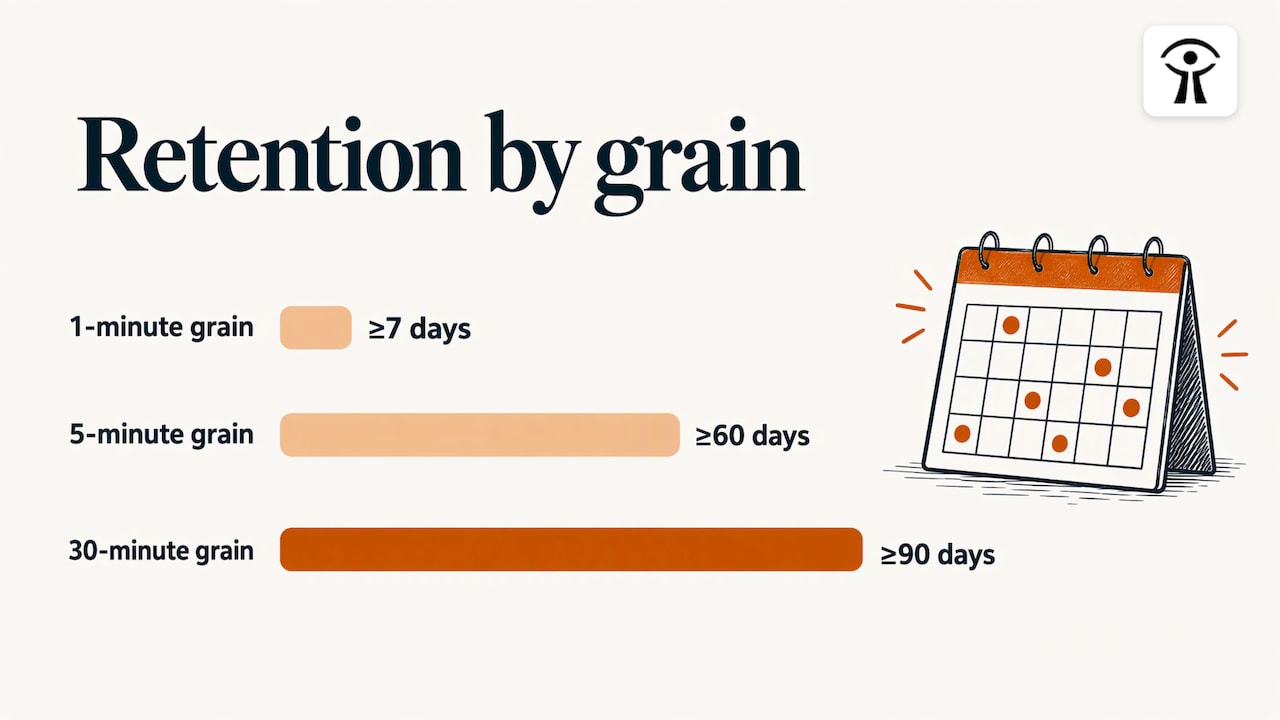
Polymarket's price series come in five grains. Per the Data API overview, they are one-minute, five-minute, 30-minute, three-hour and 12-hour. Retention differs sharply:
| Grain | Retention |
|---|---|
| 1 minute | At least 7 days |
| 5 minutes | At least 60 days |
| 30 minutes | At least 90 days |
| 3 hours | Permanent, available from July 2026 onward in the overview |
| 12 hours | Permanent |
The price-history guide adds that the permanent three-hour and twelve-hour series extend back to 18 November 2022. It also says the fine-grain horizons are minimums rather than exact windows: data expires in multi-day chunks, so it may stay available a few days longer than listed.
The consequence for anyone building a dataset is simple. If you care about minute-level behavior around an event, such as a debate, a data release or an earnings call, collect it while it is inside the window. A minute-level series for a market that closed four months ago is not something you can retrieve from the public endpoint afterward. A scheduled job that saves one-minute and five-minute series for the markets you follow gives you a private archive that outlasts the public retention.
Two other behaviors to plan for, both from the same documentation: observations can be sparse or irregular in thin markets, and requesting a bucket that is not available can return an empty page instead of an error. If a call comes back empty, check the grain against the age of the data before assuming the market has no history.
Paginating trades and other Data API calls
The Data API uses cursor-only pagination. Each response returns a next_cursor, and you pass it into the next request until the feed ends. Do not try to page by offset or page number. Because reads need no API key, you can start immediately, though you should still space out requests and handle failures with retries.
Trade history can be filtered by market, user or time range, according to the Institute's guide. This is the dataset to use when you want to know who traded, in what size and at what price, rather than only where the quoted price was. Summing trade size per day gives you a volume series that you can lay over the price series.
Order-book history: what it shows and where to get it
Price history records a single number per interval. The order book shows the resting bids and asks behind that number: how much size sits at each price level and how wide the spread is between the best bid and best ask. Two markets can both show 55% while one is deep and tight and the other is thin and wide. Reading the book is how you tell them apart. The guide to order books walks through bids, asks and depth.
For live depth, the CLOB API serves the current book. For stored snapshots of past books, the public docs are less settled than for prices, so verify the endpoint's current behavior in Polymarket's documentation before building on it. If you need depth at a past moment and cannot get it from the public sources, capture snapshots yourself on a schedule from now on. The same principle applies as with fine-grain prices: the book you do not save today is gone.
When you interpret a stored book, three readings matter most:
- Spread: the gap between best bid and best ask. A narrow spread means the quoted price is easy to act on and is a firmer probability estimate.
- Depth near the top: size within a few cents of the best price. Thin depth means a modest order moves the price.
- Imbalance: whether the bid side or ask side is heavier, which can hint at where the next move meets less resistance. Treat it as a clue, not a forecast.
Turning a price series into analysis
A raw line becomes useful once you pair it with other measurements. A reliable routine for any contract:
- Mark the events. Annotate the dates of news, filings, polls or data releases. A jump of ten points with no news behind it points to a different story than a jump on a poll release.
- Add volume. A move on heavy volume carries more information than the same move on a handful of trades.
- Check the spread. A price on a wide spread is a rough estimate. Treat it as a range.
- Compare the shape. Did the price drift gradually, spike and fade, or step? Spikes that fade often reflect a single large order or a brief news cycle. Steps usually follow information.
- Read the resolution rules. The contract pays on a defined source and definition. A price can look wrong until you read what counts. The guide on market resolution explains how to read those terms.
A worked example. Suppose a Yes token sits near $0.30 for three weeks, then steps to $0.55 across two hours on heavy volume, and the spread stays tight afterward. That pattern reads as the market absorbing new information and finding a new level with willing liquidity on both sides. Contrast it with a move from $0.30 to $0.55 across a few thin trades with a spread of ten cents: that one says little until more volume confirms it.
Limits to keep in mind
Historical data tells you what prices were. It does not tell you what happened to cause them, and several features of the data shape how far you can lean on it:
- Fine-grain series expire, so long studies at high resolution need your own archive.
- Explicit ranges are capped at 15 days per call.
- Thin markets produce sparse or irregular observations, so interpolation can invent precision that was never there.
- Token IDs, condition IDs and market IDs are different things, and mixing them yields empty or wrong results.
- A price is a probability reading only to the extent the market is liquid.
For calibration questions such as whether Polymarket predicts accurately, a price history is the starting point, not the answer. You would compare final pre-resolution prices against outcomes across many markets of a similar type and liquidity. A handful of notable hits or misses proves little.
Comparing Polymarket with Kalshi and other venues
Many readers who search for Polymarket price history are comparing contracts across venues. Kalshi exposes its own archived series through its API; its historical candlestick endpoint returns open, high, low and close values for bid and ask over periods of one minute, one hour or one day. The structures differ from Polymarket's: Kalshi gives candlesticks for a ticker, Polymarket gives a price series for a token.
When you line two venues up, normalize first:
- Same event, same wording? Two contracts on similar topics can resolve on different sources or cutoff times.
- Same price scale? Both quote in cents or dollars of a $1.00 payout, but the quoted value may be last trade, midpoint or bid, depending on the feed.
- Same time grain? Resample both to a common interval before comparing.
- Same liquidity? A gap between venues on thin markets may be spread, not disagreement.
A persistent gap on well-matched, liquid contracts is what an arbitrage scan looks for, and the Glypse Arbitrage Scanner surfaces potential gaps across venues for you to examine against the resolution rules.
Where Glypse fits
Pulling a series is the first half of the job. The second half is knowing what the series means, which requires the event context, the resolution terms and the related contracts. Glypse combines these in one workspace for Polymarket and Kalshi traders.
- Cross-venue Search finds the same event across Polymarket and Kalshi, so you can pull both series side by side.
- Research Pages give AI-generated event briefings with cited sources, so a price move sits next to the reporting behind it.
- The Market Screener filters contracts so you can shortlist markets before you spend time collecting their history.
- Social Intelligence analyzes social media posts for sentiment, emotion, conversation volume and trend changes, an alternative-data layer you can compare with price moves.
- The MCP Server lets ChatGPT, Claude and other AI agents access Glypse's market data, analytics and research, which suits analysts who want an agent to assemble the briefing.
Core research tools are free without an account. Registration adds expanded results, saved queries, longer feeds, bookmarks and MCP access. You can start from the Glypse home page and open a market's research page directly.
For more on reading prices as probabilities, see the Glypse posts on Polymarket odds and Polymarket predictions.
A repeatable workflow
Putting the pieces together, a compact research loop for one contract looks like this:
- Find the contract and its twin on the other venue with cross-venue search.
- Read the event briefing and the resolution rules.
- Pull the price series at the grain that fits your question, using
interval=maxfor the full arc. - Pull trades for volume, and save order-book snapshots going forward.
- Annotate the series with events and sentiment shifts.
- Save your notes and queries so the next update takes minutes.
The archive habit is the quiet advantage. Anyone can read the public endpoints today. A researcher who has saved fine-grain series and books for months holds data that the public retention windows no longer serve.
FAQ
Is Polymarket historical data free?
Yes for the official public endpoints. The Data API requires no API key, and price history is available through the CLOB API. Fine-grain series are kept for limited periods, so save what you need as you go.
How far back does Polymarket price history go?
The permanent three-hour and twelve-hour series extend back to 18 November 2022, per Polymarket's price-history documentation. One-minute data is kept for at least 7 days, five-minute data for at least 60 days and 30-minute data for at least 90 days.
Why does my price-history request return nothing?
The usual causes are a wrong identifier, an explicit range over 15 days, or a bucket size that no longer exists for that age of data. Confirm you are using the outcome's token_id, shorten the range, or use interval=max with a coarser grain.
Can I get Polymarket and Kalshi history in one place?
The venues publish separate APIs with different structures, so you normalize them yourself or use a workspace that does it. Glypse's cross-venue search and research pages cover both Polymarket and Kalshi markets.
How do I judge whether a historical price was reliable?
Check volume and spread at the time. A price backed by heavy volume and a tight spread is a firmer probability reading than one printed on a few trades with a wide gap between bid and ask.