Kalshi Research Platform: Tools for Studying Contracts

A good research platform for Kalshi contracts does four things in one place: it finds the right market, shows how its price got here, puts it next to related contracts on other venues, and explains the event behind it with sources you can check. Glypse is built for that workflow across Kalshi and Polymarket. Its cross-venue search, market screener, arbitrage scanner, Social Intelligence dashboard and MCP server sit in a single workspace, and the core tools are free without an account.
Key Takeaways
- Kalshi publishes a lot of its own data and research. A separate research workspace adds cross-venue comparison, event briefings with cited sources and social signals.
- Screening, price history and order book context tell you more than a single probability does.
- Cross-venue price gaps are often smaller than they look once fees, settlement differences and execution timing are counted.
- Social sentiment is a useful secondary signal when you know its limits.
- An MCP connection lets an AI agent pull market data and research directly, so your questions run against live data.
What "Kalshi research" covers
The phrase means two things. The first is Kalshi's own research arm. Kalshi Research publishes analysis on calibration, market microstructure, prediction accuracy and how participants update beliefs. Its launch study, announced in December 2025, found Kalshi inflation forecasts beat Wall Street consensus by 40% overall.
The second is the research you do on individual contracts before and after you take a view: what the market is, what it settles on, how the price moved and who else is pricing the same event. That second job is what a research platform is for.
If you are new to the vocabulary, the Glypse guides on reading a market and prices and probabilities cover the basics. A contract priced at 62¢ implies roughly a 62% chance, before fees and spread.
What the evidence says about how accurate prices are
Kalshi Research's August 2026 paper, Calibration In Prediction Markets, studied 2,324,833 resolved Kalshi markets from the 2021 launch through mid-2026. The Brier score, a measure of forecast error where lower is better, fell from about 0.08 to 0.09 at a three-month horizon to about 0.02 at close. Naive accuracy rose from 88.2% to 97.2% over the same span.
The practical reading for a researcher:
- Prices sharpen as expiry approaches, so the horizon at which you read a price matters.
- The paper finds deeper participation, meaning more volume and more unique traders, tends to sharpen prices.
- Categories with outcomes listed in advance, such as Economics, calibrate better than categories with dispersed outcomes, such as Mentions.
So before trusting any single price, check how much volume and how many participants sit behind it, and how long remains until resolution. The Glypse guide on market accuracy goes deeper on this, and the one on market resolution explains why the settlement wording is part of the research.
Step 1: Find and screen contracts
Kalshi's own interface is capable here. Its Pro markets table lets you sort and filter by category, price, size, 24-hour volume, depth, buying skew and expiry, and rows show spread and a price sparkline. That covers Kalshi alone.
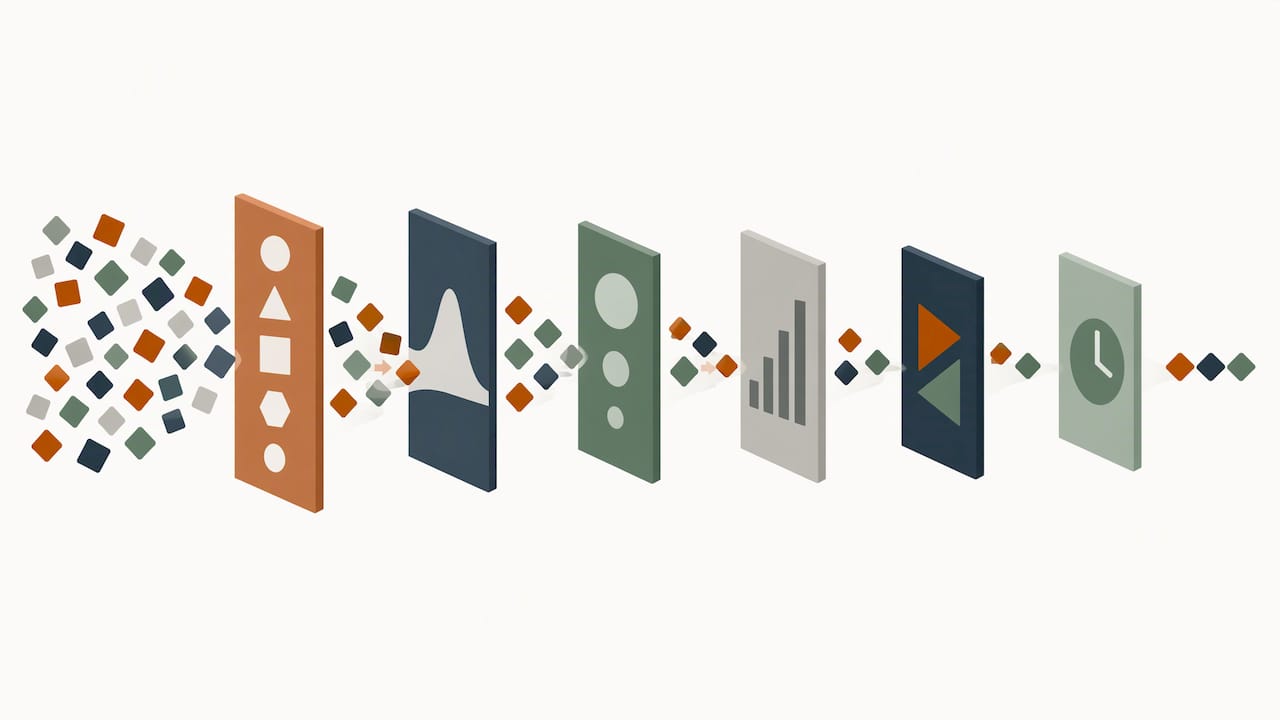
The gap appears when the same event trades on two venues, or when you want to screen on one consistent set of criteria across both. Glypse's Market Screener and cross-venue search are made for that: you search once and see related Kalshi and Polymarket contracts together, across politics, sports, crypto, economics and technology.
A screening routine that works:
- Start with a category and an expiry window, so you compare contracts that resolve on similar timelines.
- Filter for 24-hour volume and spread. A wide spread with thin volume means the displayed price is a weak estimate.
- Open the shortlist and read the resolution rules before the chart.
- Save the query so you can rerun it. Registration on Glypse adds saved queries, bookmarks and longer feeds.
Step 2: Read price history in context
A price chart answers when the market changed its mind. It does not say why. Kalshi's API documents a historical tier with candlesticks in 1, 60 or 1440-minute intervals, and settled markets before a cutoff date live in separate historical endpoints. Cutoff fields are documented in the SDK reference. Responses from the live markets endpoint are also cached, so prices can lag the exchange by several seconds.
For your own work, that means:
- Match each price move to a dated event: a data release, a poll, a ruling, a post that went viral.
- Treat a sudden jump on low volume differently from a steady repricing on high volume.
- Note which side of the book moved. Kalshi's public API exposes order book data without authentication, so depth is checkable.
Glypse's research pages pair the price history with an AI-generated briefing on the event and cited sources, which keeps the story and the chart on one screen. The pages for individual markets, such as this Kalshi event, show the format.
Step 3: Compare venues before you read a price gap
When Kalshi and Polymarket list a similar contract, a gap can look like free money. Research on it is more sober. A peer-reviewed paper by Ampel and Buckman covered 5,038 moneyline contracts across 2,519 games in four US sports leagues between September 2025 and May 2026. Closing prices on the two venues, measured at the same instant, were nearly identical: a mean absolute gap of 0.006 and a correlation of 0.998.
During live play, brief dislocations did appear. Once the authors applied each venue's fee schedule, conversion costs and execution latency, the share of affected bars dropped sharply, for example from 6.17% to 1.37% under a 15-second round trip. They also note that completed trades do not prove both legs could have been filled at the same moment, so the dislocations are upper bounds.
That gives you a verification list for any apparent gap:
| Check | Why it matters |
|---|---|
| Resolution wording | Two contracts that sound alike can settle on different sources or cutoffs |
| Fees | Kalshi charges a per-contract trading fee; Polymarket has a bid-ask spread and on-chain costs |
| Settlement currency | Kalshi settles in dollars, Polymarket in USDC |
| Depth at the quoted price | A displayed price may not fill at size |
| Timing | Prices on each venue may be captured at different moments |
The Arbitrage Scanner surfaces candidate gaps between related contracts, and the checks above are what turn a candidate into a conclusion. The Glypse guide on prediction market platforms explains how the venues differ.
Step 4: Add social sentiment, with its limits in mind
Social posts often move before an official number does, which is why traders look at them. Glypse's Social Intelligence dashboard analyzes posts for sentiment, emotion, conversation volume, hashtags and cashtags, and shows trend changes.
Academic work shows both the value and the care required:
- Sentiment tracking can follow an event as it unfolds. In a study of a 2014 crowd disaster in Shanghai, the share of negative posts rose from 27.83% before the event to 40.95% during it.
- A 2024 review lists sarcasm, irony, fragmented context, bots and fake content as the main sources of error, and says predictive power improves when social content is combined with other data.
- A Stanford study found users distrusted single-post labels, since a polite message of sympathy can be scored as positive in a negative event.
So use sentiment as a change signal. A sharp rise in conversation volume or a swing in emotion tells you where to look. Then confirm against the price history, the briefing sources and the order book.
Step 5: Put an AI agent on the data
Many researchers now ask questions through ChatGPT, Claude or another assistant. For that, the assistant needs a data connection. Kalshi's hosted MCP connector offers public tools to search markets, read event odds, market details and order books, and it cannot place or cancel orders.
Glypse's MCP Server gives agents access to Glypse's market data, analytics and research, which spans Kalshi and Polymarket. An agent can then answer a question such as "which related contracts are priced differently, and what is the event context?" from one connection. MCP access comes with registration.
A weekly research routine
This routine takes about an hour once your saved queries are set up:
- Run saved screens for your categories and note new or fast-moving contracts.
- Open each shortlisted contract's research page and read the briefing and its cited sources.
- Read the resolution wording and the expiry.
- Check price history against dated events.
- Search the other venue for related contracts and compare fees, depth and settlement terms.
- Look at sentiment and conversation volume for a change in the story.
- Record your estimate and your reasoning, so you can review how it did after resolution.
The last step builds your own calibration record, which is the same discipline Kalshi's researchers apply to the whole market.
Where Glypse fits
Glypse puts search, screening, price history, event briefings with cited sources, arbitrage scanning, social intelligence and MCP access in one workspace for Kalshi and Polymarket users. The core research tools work without an account, and registering adds expanded results, saved queries, longer feeds, bookmarks and MCP access. You can start on the Glypse home page with any event you are following.
FAQ
Does Kalshi have its own research platform?
Yes. Kalshi Research is a company arm that publishes studies on calibration, market microstructure and accuracy, and gives researchers access to internal platform data. It focuses on Kalshi's own markets. A workspace like Glypse adds cross-venue comparison, event briefings and social signals.
Can I get Kalshi market data without an account?
Kalshi's public Trade API gives unauthenticated access to series, events, markets and order book data across all categories. Glypse's core research tools are also free without an account, and registration adds saved queries, longer feeds and bookmarks.
Are price gaps between Kalshi and Polymarket tradable?
Sometimes a gap exists, but fees, settlement currency, depth and timing shape whether it holds up. A 2025 to 2026 academic study found closing prices nearly identical and live dislocations shrinking sharply after costs and latency. Compare resolution wording first.
How reliable is social sentiment for event research?
It works best as a signal of change, such as a spike in volume or a shift in emotion. Sarcasm, bots and sponsored content can distort it, so confirm it against price history and cited sources.
Can an AI agent use Glypse data?
Yes. Glypse's MCP server lets ChatGPT, Claude and other agents access its market data, analytics and research. MCP access is included with registration.